Welcome to DrumlineWarmups.com


Free drumline warmups available for download!
Download FREE drumline warmups, and you can start practicing them today! This sheet music PDF collection includes drumline music and warmups, pit percussion warmups and songs, drumset exercises, and full ensemble percussion pieces designed for individual skill development. Each exercise includes an audio sample so you can hear how it should sound while you learn it. Print the music and use the warmups with your friends completely free! Choose your instrument below...
Welcome to your FREE percussion sheet music resource!
Pick a section below and start playing these warmups. These percussion warmups and drumline sheet music exercises are designed to work with any performer and any ability level. Whether you are a beginner middle school percussion student, a high school drummer, or an independent percussionist, these exercises help build timing, technique, and overall awareness. Print the PDFs out and start learning them right away.
Select your instrumentation below:
〇
Drumline and battery exercises and warmups designed for snare, tenor, or bass drums. Focus on timing, technique, balance, and performer consistency.
|||||
Bonus content: Front ensemble warmups and exercises for keyboard percussionists. Built to improve accuracy, musicality, and performer coordination.
✖
Double-bonus content: Warmups and technical studies for drumset players. Develop coordination, control, groove, and overall playing consistency.
Free Drumline Warmups, Cadences, and Percussion Exercises
Here are the free drumline warmups and free drumline cadences you’ve been looking for! These creative and fun drumline PDF exercises, sheet music, snare warmups, songs, music, drumline cadences, and street beats are composed for all skill levels (elementary, beginner, intermediate, and advanced) and even include audio examples! Download the PDF and start practicing this music at no cost, nothing, nada, zilch, etc!Each warmup and exercise builds upon the previous one, and they’re great learning tools to progress through and develop your skills and technique. This is an entirely free drumline warmup routine and exercise program! New warmups and drumline cadences are added fairly often. Currently, you can find 250+ drumline warm ups, exercises, sight-reading passages, pit percussion / concert band exercises, and drum set warm-ups, sight-reading passages, and exercises on this site, all for free!Below are the free sheet music files divided into three separate skill levels, which let you find the right amount of difficulty for the application you need. Also included is an on-field warmup to prepare for the marching band show, and there’s even a warmdown that slowly loosens your muscles at the end of a long day!Whether you’re looking for snare sheet music, drumline exercises, or even a pre-built percussion instructional packet, we've got you covered!
Note: Click the ♫ icon below to listen to the exercise!
Download and use with your drumline:
Drumline
Warmups
Click the ♫ below to hear the music!
1. Elementary Exercise Pack:Eighths, Sixteenths, Doubles, Paradiddles ♫
(All four of these exercises are compatible with each other,
meaning they can be played at the same time, if needed.)
2. Eighths:(All compatible with pit Eighths)Stock Eighths ♫Snare Eighths Variations ♫Tenor Eighths Variations ♫Beginner – Tenor Crossover Symmetry ♫Intermediate – Tenor Crossover Asymmetry ♫Advanced – Tenor Crossover B Symmetry ♫Chaos version - Tenor Crossover C SymmemmyS ♫Bass Eighths Variations ♫Moving Eighths ♫Big Eighths ♫Eight On A Plate ♫Exhibit B (Eighths Variation) ♫Find Even More Eighths Warmups Here!
3a. Stand-Alone Variations:Countdown ♫T Minus 8 ♫PACKET EXCLUSIVE: Beginner Off Blast ♫PACKET EXCLUSIVE: Intermediate Off Blast ♫PACKET EXCLUSIVE: Advanced Off Blast ♫PACKET EXCLUSIVE: Off Blast Bucks ♫
3b. Rudimental Evidence Locker:“Where Similar Sounds Stand Trial!”GET A PHYSICAL COPY OF ALL THESE EXHIBITS AND MORE HERE!
Exhibit A (Triplets vs. Dotted Eighths) ♫Exhibit B (Sixteenth Singles vs. Diddles) ♫Exhibit C (Diddles vs. Padatas) ♫Exhibit D (PHYSICAL COPY EXCLUSIVE!)Exhibit E (Swiss Triplets vs. Inverted Rolls) ♫Exhibit F (Hertas vs. Diddles) ♫Exhibit G (Flam Taps vs. Inverted Flam Taps) ♫Exhibit H (PHYSICAL COPY EXCLUSIVE!)Exhibit I (Floppies vs. Diddles) ♫Exhibit J (Accented Sixteenths vs. Accented Triplets) ♫Exhibit K (PHYSICAL COPY EXCLUSIVE!)Exhibit L (Paradiddle Taps vs. Fivelets) ♫
(Submit your own “Exhibit” suggestions here!)
4. Singles Placement Control:Beginner – Work Placement ♫Intermediate – Work Placement ♫Advanced – Work Placement ♫Intermediate – Alternate Work Placement (Single Stroke Rolls) ♫Advanced – Alternate Work Placement (Single Stroke Rolls) ♫
(Compatible with Beginner Roll Program)Cruise Control ♫Find Even More Singles Warmups Here!
5. Heights / Accents:Beginner – New Heights ♫
(Compatible with pit New Heights)Intermediate – New Heights ♫
(Compatible with pit New Heights)Advanced – New Heights ♫
(Compatible with pit New Heights)Heights Tag ♫New Heights (Flam On One) ♫
(Compatible with pit New Heights)I Know What You Grid Last Summer ♫Accentual Healing ♫2⁸ (Accents) ♫Find Even More Heights Warmups Here!
6. Multiples / Doubles:Beginner – Double Action ♫Intermediate – Double Action ♫Advanced – Double Action ♫Double Trouble ♫Triple-Double ♫Quadruple Trouple ♫Left Is More ♫Find Even More Double/Triple Warmups Here!
7. Paradiddles:Beginner – Para Para ♫Intermediate – Para Para ♫Advanced – Para Para ♫Paradiddles Tag ♫Tony, Think Of A Clever Title For This Paradiddle One ♫Tony, I Need You To Name This Paradiddle Version Too ♫Find Even More Paradiddle Warmups Here!
8. Rolls:Beginner – Roll Program ♫Intermediate – Roll Program ♫Advanced – Roll Program ♫Advanced – Roll Program (Alternate) ♫Tricklet Rolls ♫Tenor Roll Patterns ♫
(Use with any roll exercises)Roll Models ♫Ned (Diddly) Flanders ♫2⁸ (Diddles) ♫Find Even More Rolls Warmups Here!
9. Flams:Beginner – Flams ♫Beginner – Flams (Alternate) ♫Intermediate – Flåm Norway ♫
(Compatible with pit Flåm Norway)Advanced – Flåm Norway ♫
(Compatible with pit Flåm Norway)I Know What You Grid Last Summer (Flam on One) ♫I Still Know What You Grid Last Summer ♫Unflamiliar Territory ♫Ned Flamders ♫Flamly Matters ♫Invertigo ♫Intermediate – Small Fadoy ♫Advanced – Small Fadoy ♫2⁸ (Flams) ♫Find Even More Flam Warmups Here!
10. Longform Drumline Warmups:Intermediate – Etude Warmup ♫Advanced – Etude Warmup ♫Uncle Lefty’s Chop Shop ♫Find Even More Longform Warmups Here!
11. On-Field:Big Eighths ♫Slow Fast ♫Intermediate – Small Fadoy ♫Advanced – Small Fadoy ♫Toast ♫The Last Word ♫Find Even More On-Field Warmups Here!
12. Warmdown:Sixteenths
(Compatible with pit Sixteenths)
13. Overall Assessments:Torque Test (Full Score) ♫
(A tractor-pull-style drumline assessment.)Torque Test (Snare Drum Part) ♫
(A tractor-pull-style snareline assessment.)Torque Test (Tenor Drum Part) ♫
(A tractor-pull-style tenorline assessment.)Torque Test (Bass Drum Part) ♫
(A tractor-pull-style bassline assessment.)Sight Reading Level Assessments
These warmups are free to use. If you find them useful,
buying me a coffee is a great way to say thanks!
Drumline Cadences!
Drumline Cadences & Street Beats for ALL Skill Levels:
The following drumline and battery cadences are designed for various skill levels. Each of the drumline street beats is divided into three sub-categories of skills so that you can really dial in the ideal choice! Enjoy these four titles and twelve drum cadence options!
These percussion music PDF files are shared under a Creative Commons license, so anyone can freely use them for rehearsals, practice, and instructional settings.
Special thanks to Chris Wildrick for allowing me to arrange a cadence he originally wrote for my alma mater drumline.
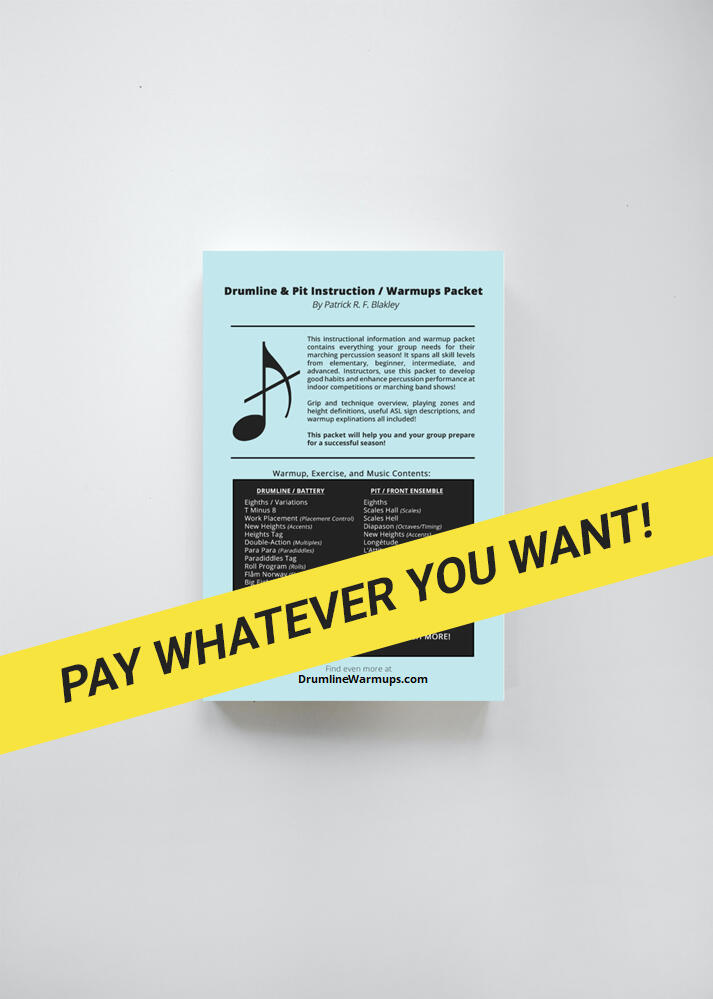
Pay what you want for the FULL Instruction Packet:
FULL Technique Overview Packet
If you like these free drumline warmups, take the next step with the complete collection at DrumPacket.com. The Drum Packet is a full percussion program resource where you can download the entire set of warmups plus a detailed technique and instruction outline designed to help you build and organize your drumline, pit, or full percussion section.It includes packet exclusive warmups, expanded exercises, teaching descriptions, and rehearsal ideas that show you how to actually implement the material with your group. The best part is that you choose the price!Pay whatever you want and get a complete drumline warmup packet that gives you structure, ideas, and practical tools you can start using at rehearsal immediately.
If you are looking for free drumline music to learn and play on your own, you are in the right place. This collection is built for drummers who want real, playable material that develops hands, timing, and control while still sounding like actual drumline writing. Whether you play snare, tenors, or bass drum, these free drumline sheet music PDFs give you immediate access to exercises, cadences, and ensemble parts you can download and start practicing right away. The focus here is simple: clean writing, clear rhythms, and material that actually helps you get better behind the drum.Free drumline cadences are one of the best ways to build confidence and groove as a marching percussionist. These cadences are written to be playable, musical, and fun to repeat, not just random sticking patterns. You will find street style grooves, traditional drumline cadences, and modern hybrid ideas that help you lock in time while still sounding powerful in a group setting. If you want free drumline cadences that feel like real drumline music instead of practice filler, these are designed to keep you engaged while you improve.Every piece of free drumline sheet music here is written to be easy to read so you can spend more time playing and less time figuring things out. The free drumline exercises focus on real playing skills like timing consistency, diddle control, accent tap flow, and bass drum part independence. These are the kinds of patterns that show up in actual drumline music, so you are not just practicing in isolation, you are building skills that transfer directly into performance situations.All of the free drumline downloads are ready to go instantly. You can grab the PDFs, print them, and start practicing without signups or extra steps. This is important because most drummers just want something they can use immediately, not a long process to get access. The goal is simple access to useful free drumline music that you can put on the stand and start working through today.Free drumline beats and street beats are a major part of developing groove and ensemble awareness. These patterns are designed to feel like real drumline playing, where each section has a clear role. Snare parts stay clean and articulate, tenor parts add movement and flow, and bass drum parts lock in the foundation. If you are trying to find free drumline street beats that actually feel like something you would hear on a field or in a lot, these are built to sound and feel authentic.If you are a drummer working on your own improvement, having consistent access to free drumline music matters. These free drumline PDFs give you a steady flow of exercises and cadences so you can build consistency in your hands and timing without needing expensive packets or programs. From entry level patterns to more advanced rhythmic challenges, everything here is designed to push your playing forward in a real, practical way.In short, if you are searching for free drumline music, free drumline sheet music, free drumline exercises, free drumline downloads, free drumline beats, free drumline street beats, and free drumline cadences, this collection is built for drummers who want to learn, practice, and improve. Download, print, and play!
Bonus: FREE Pit & Concert Music:
Pit & Concert Warmups
Click the ♫ below to hear the music!
1. Eighths:(Compatible with drumline Eighths)Stock Eighths ♫
2. Scales Hall:Beginner – Scales ♫Intermediate – Scales ♫Advanced – Scales ♫
3. Scales Hell:Scales Hell ♫
4. Diapason (Octaves):Beginner – Octaves ♫Intermediate – Octaves ♫Advanced – Octaves ♫
5. New Heights (Accents):(Compatible with drumline New Heights)Beginner – Heights ♫Intermediate – Heights ♫Advanced – Heights ♫
6. Longétude:Beginner – Longétude ♫Intermediate – Longétude ♫Advanced – Longétude ♫
7. L’Attitude (Chromatics):Beginner – Chromatics ♫Intermediate – Chromatics ♫Advanced – Chromatics ♫
8. Flåm Norway (Flams):(Compatible with drumline Flåm Norway)Intermediate – Flams ♫Advanced – Flams ♫
9. Steven Deadly Sins (Four Mallets):Intermediate – Four Mallets ♫Advanced – Four Mallets ♫
10. Warmdown:(Compatible with drumline Sixteenths)Sixteenths
These warmups are free to use. If you find them useful,
buying me a coffee is a great way to say thanks!
Pit Songs & Etudes!
‡ Front Ensemble Music, Etude Warmups, and Mini Exercise Songs:
The following pit warmups and front ensemble exercises are short musical pieces designed to highlight specific techniques and playing styles. These mini productions create a more realistic performance environment while still functioning as effective warmups for the front ensemble. (Note: Mallet parts can be used by any instrumentation! Aux percussion can be added to all music.)
‡ Canpakes ♫
(Moderate difficulty. 5 mallet instruments, 1 synth.)
‡ Molecular Astronomy ♫
(Intermediate difficulty. 6 mallet instruments, 0 synth.)
‡ Real Strong Wizard ♫
(Advanced difficulty. 4 mallet instruments, 2 synths.)
‡ Remarkably Mad Mollusks ♫
(Moderate difficulty. 4 mallet instruments, 1 synth.)
‡ Universe In A Crayon ♫
(Intermediate difficulty. 4 mallet instruments, 0 synth.)
‡ Proshchay ♫
(Beginner difficulty. 6 mallet instruments, 0 synth.)
These percussion music PDF files are shared under a Creative Commons license, so you can freely use them.‡ The music may not be used in ticketed performances, paid events, or any production with paid spectators. For permission to use this music in a paid performance, contact Licenses@DrumlineWarmups
Special thanks to Chris Blakley and David Maxim Micic for giving me permission to arrange their tunes!
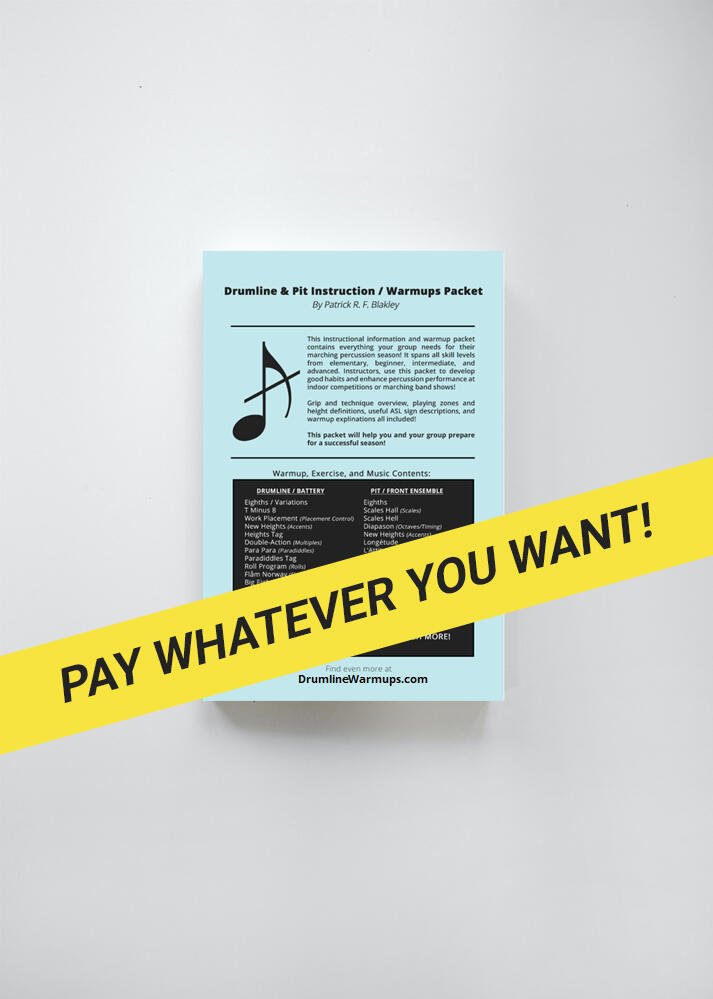
Pay what you want for the FULL Instruction Packet:
FULL Technique Overview Packet
If you like these free pit warmups, take the next step with the complete collection at DrumPacket.com. The Drum Packet is a full percussion program resource where you can download the entire set of warmups plus a detailed technique and instruction outline designed to help you build and organize your drumline, pit, or full percussion section.It includes packet exclusive warmups, expanded exercises, teaching descriptions, and rehearsal ideas that show you how to actually implement the material with your group. The best part is that you choose the price!Pay whatever you want and get a complete drumline warmup packet that gives you structure, ideas, and practical tools you can start using at rehearsal immediately.
If you are looking for free front ensemble music to practice and improve your playing, you are in the right place. This collection is built for pit percussionists who want real, playable material that develops timing, coordination, and musical control across marimba, vibraphone, xylophone, and auxiliary percussion. These free front ensemble sheet music PDFs are designed for individual players who want something they can download instantly, put on the stand, and start working through without hassle. The goal is simple: better playing through clear, usable music.Free front ensemble sheet music should be easy to read and immediately playable, and that is exactly what these PDFs are designed for. Each part is written so you can focus on your technique instead of decoding confusing notation. Whether you are working on two mallet fundamentals, four mallet independence, or basic keyboard control, these free pit percussion exercises give you structured material that builds real skill. If you want free front ensemble sheet music that actually helps you sound better, this is built for that purpose.Free front ensemble exercises are a key part of becoming a stronger keyboard percussionist. This collection includes scale work, interval training, rhythm studies, and coordination exercises that help you lock in timing and improve accuracy. These free pit percussion exercises are not just technical drills, they are written to feel like real music so your practice connects directly to performance. If you are trying to build consistency and control, this material gives you a clear path forward.All of the free front ensemble downloads are ready to use immediately. You can download the PDFs, print them, and start practicing right away without any signups or delays. These free pit percussion downloads are organized for convenience, so you can spend your time playing instead of searching. If you need reliable free front ensemble music that is ready when you are, this library keeps the process simple.Free front ensemble beats and grooves help you understand how keyboard percussion fits into the bigger picture of the drumline. These parts are written to feel musical and supportive while still giving you something engaging to play. Marimba and vibraphone lines focus on harmony and rhythm, while auxiliary percussion adds color and texture. If you want free front ensemble grooves that actually feel like real ensemble writing, these examples help you develop better musical awareness and timing.If you are practicing on your own, having access to quality free front ensemble music can make a real difference. These free pit percussion PDFs give you consistent material to work through so you can build strength, control, and confidence over time. From early level patterns to more advanced four mallet challenges, everything here is designed to support real improvement, not just fill time.In short, if you are searching for free front ensemble music, free front ensemble sheet music, free front ensemble exercises, free front ensemble downloads, free front ensemble beats, and free pit percussion sheet music, this collection is built for players who want to practice with purpose and get better every day. Download, print, and play!
Double-Bonus: Drumset Music:
Drum Set Exercises
Click the ♫ below to hear the music!
1. Embellishments:Stock Embellishments
2. Filler:Beginner Filler ♫Intermediate Filler ♫Advanced Filler ♫
3. Multiple Hands:Beginner Multiple Hands ♫Intermediate Multiple Hands ♫Advanced Multiple Hands ♫
4. Multiple Feet:Beginner Multiple Feet ♫Intermediate Multiple Feet ♫Advanced Multiple Feet ♫
5. Paradiddles:Beginner Paradiddles ♫Intermediate Paradiddles ♫Advanced Paradiddles ♫
6. Sixteenth Note Variations:Bass Drum Sixteenth Note Patterns ♫Snare Drum Sixteenth Note Patterns ♫Combined Bass & Snare Sixteenth Note Patterns ♫Hihat Sixteenth Note Patterns ♫
7. Patrick's Favorites:Patrick's Favorite Rudimental Drumset Grooves
This collection takes some of my favorite rudimental patterns and transforms them into high-energy, musically complex drumset grooves! The core idea is to take stickings and phrasing that marching percussionists already know, like paradiddles, flams, rolls, and hybrid rudiments, then flip them into creative orchestrations across the kit.Instead of just playing everything on a snare drum, these grooves split the hands between different voices, like the hi-hat and snare, hi-hat and ride, or even two different hi-hats. That separation creates a stereo feel and adds a layer of phrasing and texture that goes way beyond traditional rudimental practice.Whether you’re a drumline vet looking to bring your hands to the drumset or a kit player wanting to break out of the usual groove vocabulary, these patterns are made to inspire. They’re technically demanding, but when they click, the musical payoff is massive. Marching band drummers will feel right at home, and probably wish they had a second hi-hat.
⭐️ Eighth-Note Bass Drum Groove Study:All 256 Bass Drum Eighth-Note BACKBEAT Grooves ♫32+ Standard Eighth-Note BACKBEAT Grooves ♫All 256 Bass Drum Eighth-Note HALF TIME Grooves ♫64+ Standard Eighth-Note HALF TIME Grooves ♫
Sixteenth-Note Bass Drum Groove Study:8,195+ Standard Sixteenth-Note Grooves!
The sixteenth-note groove exercise above lists ALL 8,195 possible bass drum patterns that contain a downbeat and no bass drum notes under the snares. Without those simple restrictions, there would be 65,536 possible measures! Pick a row and try to play it! (See the instructions tab for more info, this document is pretty intuitive.) This file also includes a bunch of bonus grooves that actually incorporate bass drum notes under the snares for common patterns and even some that don’t start on beat one! Enjoy!
‼️ Ultimate Drum Groove Generator:Download the Adaptive Groove Generator
This is a rule-based groove engine capable of generating over 10⁵⁷ unique drum patterns across multiple instrument layers and performance modes. Drummers can find simple grooves instantly, or explore rhythmic depths when ready for more advanced grooves!
These warmups are free to use. If you find them useful,
buying me a coffee is a great way to say thanks!
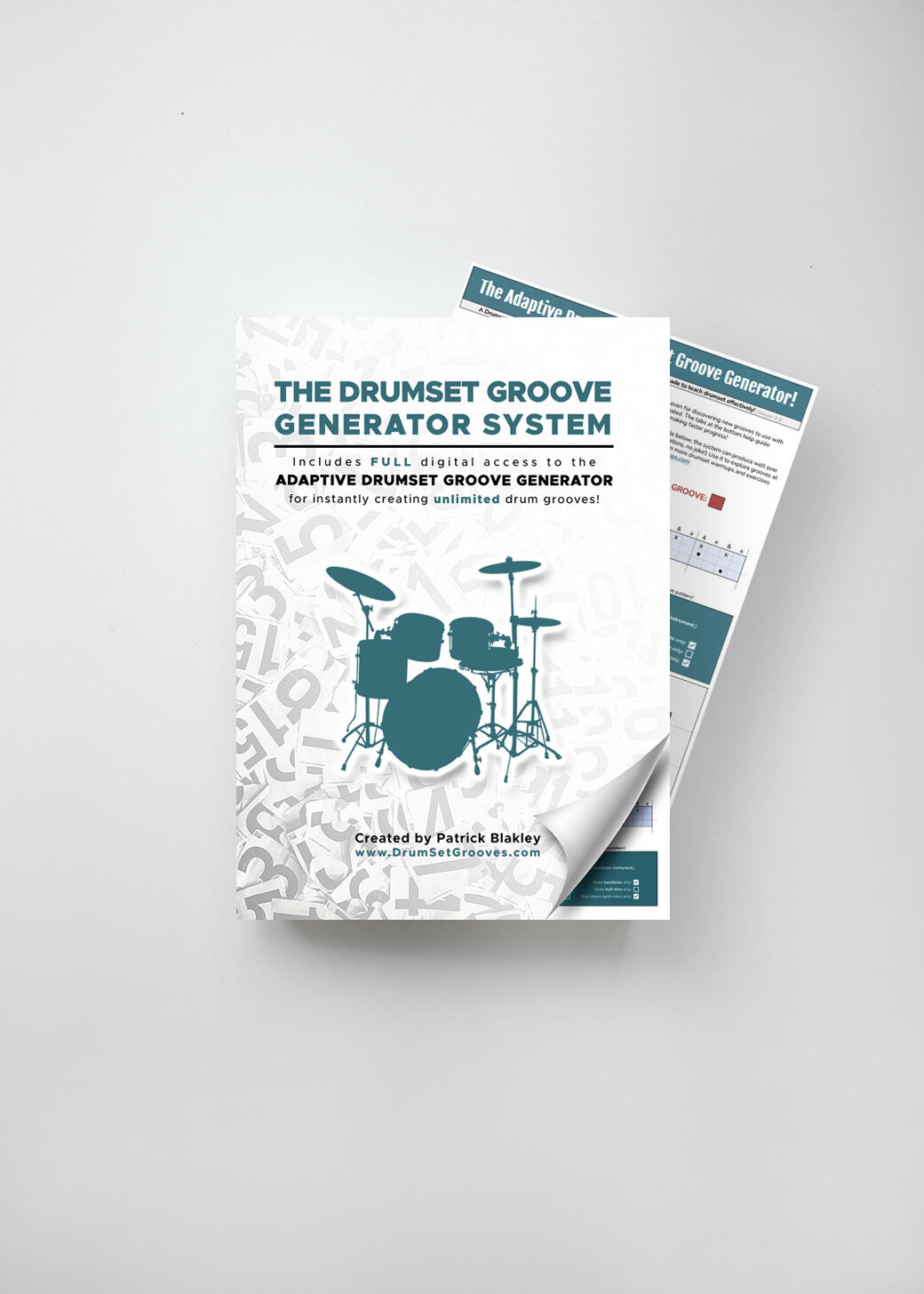
Create endless grooves with one click:
The Drum Groove Generator Tool!
The Drumset Groove Generator Tool is a rule-based practice and teaching tool that instantly creates unlimited drum grooves with a single click. Designed for drum teachers, students, and working musicians, it replaces static exercises with a customizable system for developing groove vocabulary and coordination.Using simple checkboxes, you can control hi hat patterns, snare placement, bass drum coordination, and more. Every generated groove follows your selected rules while creating fresh rhythmic variations for practice, teaching, composition, and performance.Whether you are building lesson plans, improving independence, overcoming writer’s block, or expanding your drumset vocabulary, this system delivers practical, playable grooves on demand!
If you are looking for free drumset music to practice and improve your playing, you are in the right place. This collection is built for drummers who want practical, musical material they can use immediately behind the kit. These free drumset sheet music PDFs focus on real skills like groove, timing, coordination, and independence across styles like rock, funk, jazz, and pop. Everything is designed so you can download it, set it on the stand, and start playing without extra setup or confusion.Free drumset sheet music should be clear and directly playable, not something you have to decode before you can practice. These free drum set PDFs are written so you can focus on feel, consistency, and execution at the kit. You will find grooves, fills, and song style patterns that translate directly into rehearsal, practice, or live playing situations. If you want free drumset sheet music that actually sounds like music instead of isolated exercises, this collection keeps things practical and playable.Free drumset exercises are where real improvement happens. This collection includes coordination drills, limb independence work, timing studies, and groove development patterns that build control over time. These free drum set exercises are focused on real world playing skills like pocket consistency, dynamic control, and limb coordination so your drumming feels more solid and confident. If you are trying to find free drumset exercises that actually change how you play, this material is built for that purpose.All of the free drumset downloads are available instantly, so you can start practicing right away. Each free drumset PDF is formatted for quick printing and immediate use, with no signups or barriers. The goal is to remove friction so you spend more time at the kit and less time searching for usable material. If you need dependable free drum set downloads that you can rely on for daily practice, this library keeps it simple.Free drumset beats and grooves form the core of developing strong time and feel. These free drum set beats cover essential styles including rock, funk, jazz ride patterns, and pop grooves. Each one is written to emphasize pocket, consistency, and musicality so you can lock in with other musicians or backing tracks. If you are looking for free drumset beats that actually help you play tighter and more confidently, these grooves are designed for real improvement.Free drumset grooves also include variations and fills that expand your vocabulary in a practical way. Instead of overly complex patterns, you will find usable groove variations, ghost note ideas, and fill concepts that connect naturally between phrases. These free drum set grooves are built to be played, not just studied, giving you material you can immediately apply in real playing situations.If you are practicing on your own, having consistent access to free drumset music helps you stay focused and progressing. These free drum set PDFs provide structured material that builds coordination, timing, and musical awareness over time. From simple rock beats to more advanced independence challenges, this collection supports a wide range of skill levels while staying centered on real drumming outcomes.In short, if you are searching for free drumset music, free drum set sheet music, free drumset exercises, free drum set downloads, free drumset beats, and free drum set grooves, this collection is built for drummers who want practical material that improves their playing. Download, print, and play!
Marching percussion FAQ:
Frequently Asked Questions About Drumline
What is a drumline?
A drumline is a group of percussionists who perform together as part of a marching band, indoor percussion ensemble, or drum corps. It typically includes snare drums, tenor drums, bass drums, and sometimes cymbals. Drumlines combine rhythm, visual performance, and coordination to create both musical and visual impact.What instruments are in a drumline?
A standard drumline includes:
Snare drums, tenor drums (also called quads or quints), bass drums in multiple sizes, and marching cymbals. Some ensembles also include pit instruments, aka the pit. The front ensemble or pit instruments are things like marimba, vibraphone, and electronic percussion, though these are not part of the marching battery.What is the difference between battery and front ensemble?
The battery refers to the marching percussion section that moves on the field, including snare, tenor, bass, and cymbals. The front ensemble also called the pit is stationary and includes keyboard percussion and auxiliary instruments.How hard is drumline?
Drumline is physically and mentally demanding. It requires coordination, endurance, timing accuracy, and memorization. Marching while playing adds another layer of difficulty, especially at higher competitive levels.How do you join a drumline?
You can join a drumline by auditioning for your school band, indoor percussion group, or independent ensemble. Most groups require you to demonstrate basic technique, timing, and the ability to learn music quickly.What should I practice for drumline auditions?
Focus on rudiments like singles, doubles, and paradiddles to start. Play any drumline warmups from this website with a metronome for timing. Work on consistent control at multiple tempos, stick heights and basic marching technique if applicable.What are drumline rudiments?
Rudiments are the fundamental sticking patterns used in drumming. Common rudiments include single strokes, double strokes, paradiddles, flams, and drags. These are the foundation of drumline technique and vocabulary.How long does it take to get good at drumline?
Progress depends on consistency and quality of practice. Beginners can develop solid fundamentals within a few months, while advanced performance typically takes several years of focused training.What is the hardest drumline instrument?
Snare drum is often considered the most technically demanding due to its precision and exposed parts. Tenor drums require complex movement and spatial awareness. Bass drum demands strong timing and listening skills as players perform interlocking parts.What is marching tenor drums?
Marching tenor drums also called quads or quints consist of multiple drums mounted together. Players move between drums to create melodic patterns and visual sweeps.How heavy is a drumline drum?
Weights vary: Snare drums are typically 15 to 25 pounds. Tenor drums can range from 25 to 40 pounds. Bass drums vary by size but can be 15 to 35 pounds. Carriers and harnesses distribute the weight across the body.Do you need to read music for drumline?
Yes, reading percussion notation is important for most drumlines. However, beginners can often start by learning by ear and gradually develop reading skills.What is drumline notation?
Drumline notation uses a staff similar to traditional music, but each line or space represents a different drum or sound. Rhythms are written the same way as standard music notation.How do you improve timing in drumline?
Use a metronome consistently. Practice slow and gradually increase tempo. Record yourself and listen for accuracy. Playing with others also improves internal timing and awareness.What is a metronome and why is it important?
A metronome is a tool that produces a steady pulse. It helps drummers maintain consistent tempo and develop strong timing, which is critical in drumline performance.How do you march and play at the same time?
This requires coordination between upper body playing and lower body movement. Players practice marching fundamentals separately and then combine them with playing through repetition.What are drumline visuals?
Visuals are choreographed movements that enhance the performance. These can include stick tricks, body movements, and coordinated gestures that match the music.What is a drumline cadence?
A cadence is a piece of music played by the drumline, often in parades or stands. It is usually looped and designed to maintain a steady groove while marching.What is indoor percussion?
Indoor percussion also known as winter percussion is a competitive activity performed inside gyms or arenas. It combines drumline, front ensemble, and theatrical elements.What is DCI drumline?
DCI drumline refers to drumlines in Drum Corps International, a high-level competitive marching activity. These groups perform complex music and visuals at an elite level.How often should I practice drumline?
Daily practice is ideal, even if short. Consistency is more important than long sessions. Focus on fundamentals, technique, and musicality.Can beginners join drumline?
Yes. Many school programs accept beginners and teach fundamentals from the ground up. Private lessons can accelerate progress significantly.What sticks do drumline players use?
Drumline players use specialized marching sticks and mallets designed for durability and projection. Snare sticks are thicker, tenor mallets have nylon heads, and bass mallets vary by drum size.How do you prevent injury in drumline?
Use proper technique, warm up before playing, and avoid excessive tension. Stretching and strengthening exercises can help prevent strain.Why is drumline important in marching band?
The drumline provides the rhythmic foundation of the ensemble. It drives tempo, enhances musical impact, and contributes significantly to the visual performance.What makes a good drumline player?
A strong drumline player has consistent timing, solid technique, good listening skills, iscipline and focus, ability to perform under pressure.How do I get better at drumline fast?
Work with a qualified instructor, practice with a plan, use a metronome, and focus on fundamentals daily. Recording and reviewing your playing can accelerate improvement.
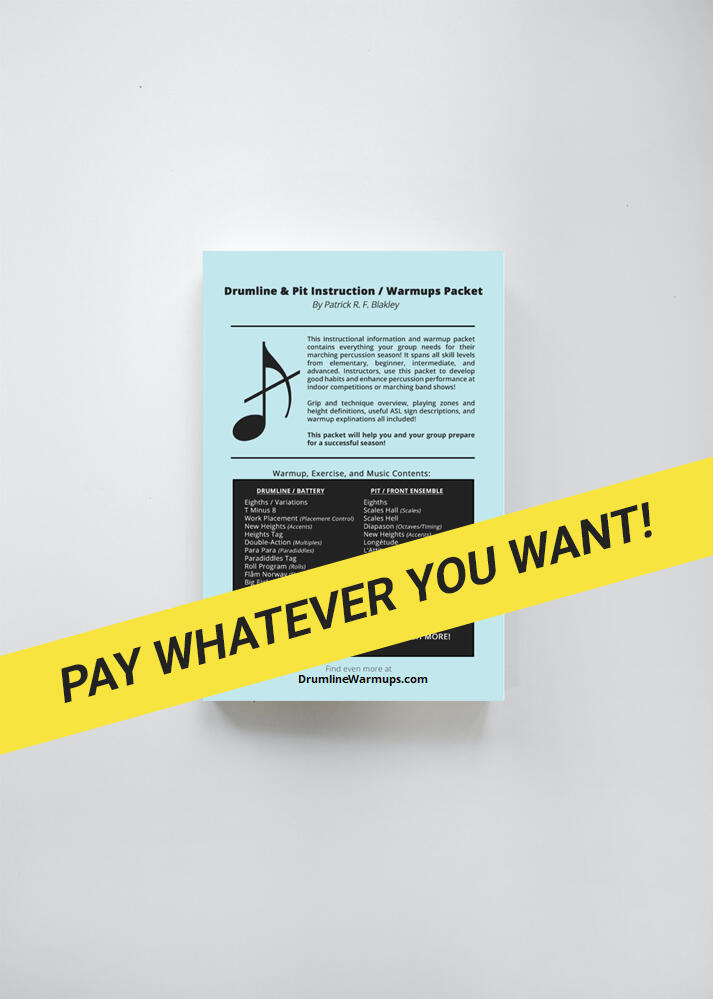
Get the full technique and instruction packet:
DrumPacket.com
If you like these free drumline warmups, take the next step with the complete collection at DrumPacket.com. The Drum Packet is a full percussion program resource where you can download the entire set of warmups plus a detailed technique and instruction outline designed to help you build and organize your drumline, pit, or full percussion section.It includes packet exclusive warmups, expanded exercises, teaching descriptions, and rehearsal ideas that show you how to actually implement the material with your group. The best part is that you choose the price!Pay whatever you want and get a complete drumline warmup packet that gives you structure, ideas, and practical tools you can start using at rehearsal immediately.
Then test your abilities at:
DrumAudit.com
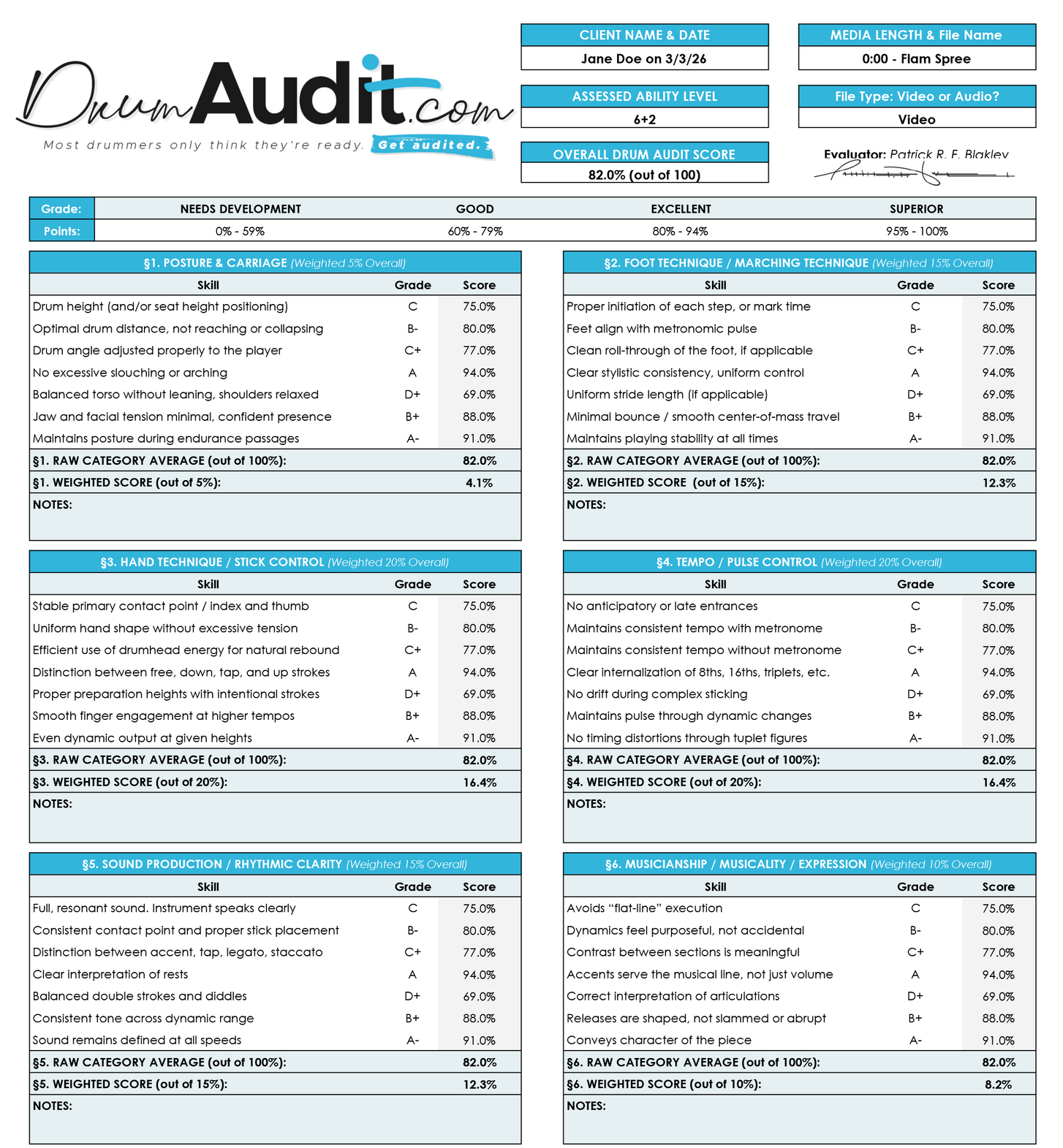
If you want detailed feedback on how you actually perform these exercises, check out DrumAudit.com. Drum Audit lets you submit a video of yourself playing any of these warmups or anything else you want to perform and receive honest, detailed feedback from an experienced percussion judge.Your evaluation focuses on timing, sound quality, technique, consistency, and overall musical clarity, along with specific suggestions you can use to improve immediately. It's a simple way for individual drummers to receive professional level feedback and a clear understanding of what is working, what needs attention, and how to take their playing to the next level!

About the composer:
Patrick Blakley
My name is Patrick Blakley, and I have been performing and teaching percussion for more than three decades. I currently serve as a music judge for competitive marching circuits in seven states and am a certified percussion judge with Winterguard International. My drumline exercise and warmup method book has been used by more than 350 schools in 45 states, as well as by groups in Canada, Australia, Japan, South Korea, and Europe.I'm also the author of two marching percussion instructional books, along with a marching band themed novel and a children’s book about the marching arts!Join hundreds of other students who have already fine-tuned their drumming through focused evaluation and clear, actionable feedback developed over my 30+ years of teaching. My students have gone on to march with top DCI and DCA drum corps, WGI World Class drumlines, and performed drumset for Billboard Top 100 Artists!Learn even more about Patrick Blakley over at PatrickBlakley.com
More useful marching band and drumline links:
Use these warmups with the Performance-Ready Method: A Drumline Rehearsal System!The Quarterly Note: A way for me to say thanks for supporting my work.Many of these warmups can be found on the DRUMR app. Check it out!

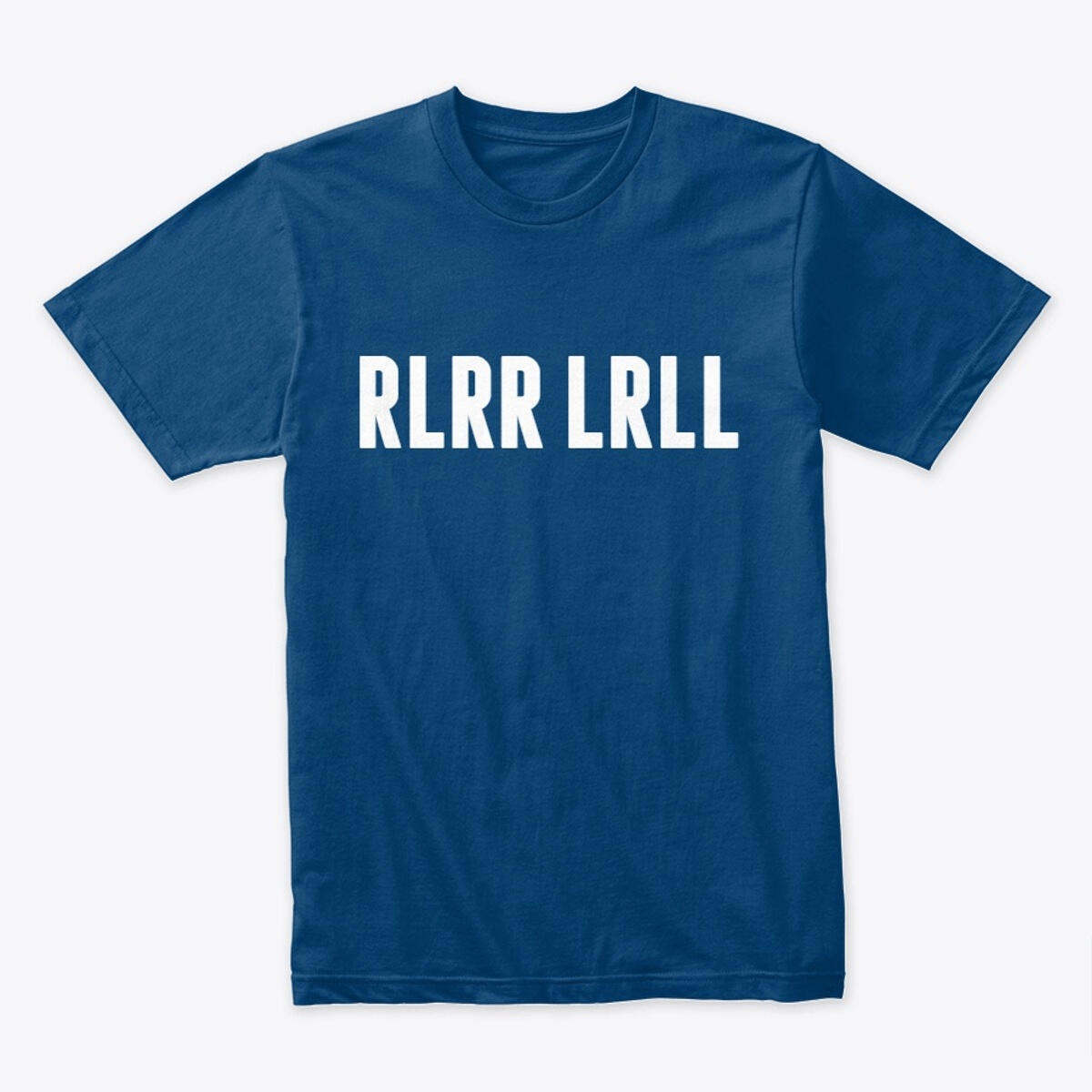
Play them. Wear them!
For drummers who live in the lot and think in grids. Wear it loud. Wear it proud.
Let the world know where you stand in the ensemble.
Thank you!
Thank you for taking the time to explore these drumline warmups. These materials are built to help you develop stronger fundamentals, clearer technique, and a more confident ensemble sound. Whether you are using them in rehearsal, individual practice, or as part of your full percussion program, I appreciate your support and commitment to improving your group. Keep working, stay consistent, and make every rep count.

These drumline warmups are shared under a Creative Commons style license so educators, students, and ensembles can freely use them for rehearsals, practice, and instructional settings. Feel free to download, print, and use the music with your drumline, percussion section, or individual practice.‡ The music may not be used in ticketed performances, paid events, or any production with paid spectators. For permission to use this music in a paid performance, contact [email protected]
Director of Title Strategy: Anthony B. Loughnei

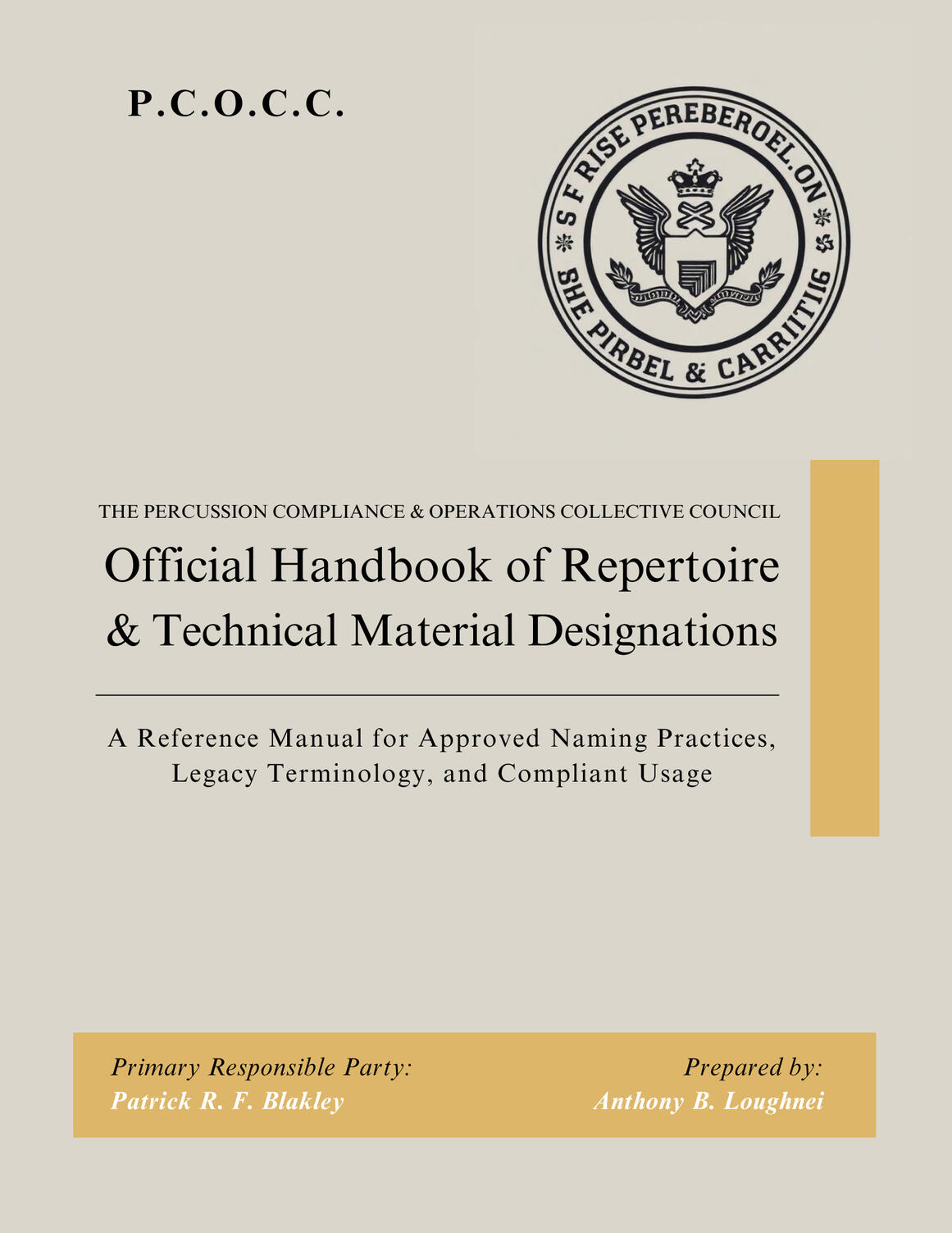
Tony isn’t the one holding sticks or setting tempos. He’s not behind a keyboard typing out notation either. Tony is the Director of Title Strategy here at DrumlineWarmups.com, and while his role might sound made up, it’s arguably one of the most important jobs on the team. He’s the reason your warmup routine starts with a smirk.Tony holds a master’s degree in linguistics and sociolinguistics with a focus on onomastics and ergonymy. He is a member and certified nomenclator through the Percussion Compliance & Operations Collective Council (PCOCC), and he also prepared the PCOCC handbook!While others sweat over flams and drags, Tony sweats over words. His mind lives somewhere between a poet and a prankster, a historian and a hype man. Every name he crafts carries intention. Some are subtle nods to percussion history. Others are inside jokes that only your section will understand by finals week. And some are just so weird and oddly specific, you’ll be saying them out loud for years without ever knowing why they work. But they do. Every time.Tony approaches each new title like a master distiller refining his latest batch. He pulls in flavor from the feel of the exercise, the groove of the rudiments, and the shared identity of the percussion sections. Then he trims away everything unnecessary until he’s left with something clean, clever, and totally unforgettable.It’s equal parts wordsmithing and wizardry. And like any true artist, Tony doesn’t explain his process. He just sends over the title and disappears into the mist. No follow-up, no context. Just a word or phrase that somehow captures the exact vibe of an exercise built to melt your hands off. You’ll never fully understand how he does it. But you’ll always know when it’s his.Without him, rehearsal would just be noise without a name.If you’d like to request a warmup name from Tony, please reach out to him on the BlueSky app! Tony can also be contacted by email: [email protected]
Tony’s Official Job Description
Director of Title StrategyRole Summary:
The Percussion Director of Title Strategy is responsible for the creative development and assignment of titles for all percussion warmups and exercises. This role requires a deep understanding of percussion pedagogy, ensemble culture, and the unique identity of the percussion community. By crafting names that are memorable, engaging, and aligned with the spirit and function of each piece, the Director of Title Strategy helps establish a consistent brand voice and enhances the educational and motivational value of each exercise.Working closely with percussion arrangers, educators, and content developers, this role ensures that every title reflects the character, difficulty, or thematic intent of the material. A successful candidate brings a strong sense of language, tone, and creative alignment, along with a sharp ear for the subtle humor and traditions that define percussion culture.This position plays a key role in creating cohesion across the curriculum and enriching the overall experience for performers and instructors alike.
Key Responsibilities:Inventing warmup titles that are simultaneously cryptic, clever, and impossible to forget
Balancing humor, tradition, and inside jokes in every name
Keeping the drumline guessing with titles that spark curiosity and camaraderie
Approving (or silently vetoing) any suggested title not up to the Tony standard
Maintaining the Codex of Warmup Names — a sacred, mostly blank book that serves as a ceremonial prop
Serving as the unofficial morale officer through the power of perfectly named drillsQualifications:
Exceptional creativity and a deep love for wordplay
An encyclopedic knowledge of rudiments, marching band culture, and bad puns
Ability to work under pressure and with minimal input (because Tony likes to keep things mysterious)
A sense of humor sharp enough to cut through the loudest drumline chaos
Tony’s FAQ: The Director of Title Strategy EditionQ: Is Tony a drummer?
A: Nope. Tony doesn’t touch a stick. His instrument is language.Q: How does Tony come up with the names?
A: Legend says it involves coffee, a thesaurus, and maybe a dash of magic.Q: Why are the titles always weird or funny?
A: Because Tony believes warmups should be memorable, and keeps the line on its toes.Q: Can we suggest names to Tony?
A: You can try, but Tony’s veto power is real, and he loves to keep things his own.Q: Where does Tony keep the official list of warmup titles?
A: In the Codex of Warmup Names, a notebook he waves around for dramatic effect.